Automotive
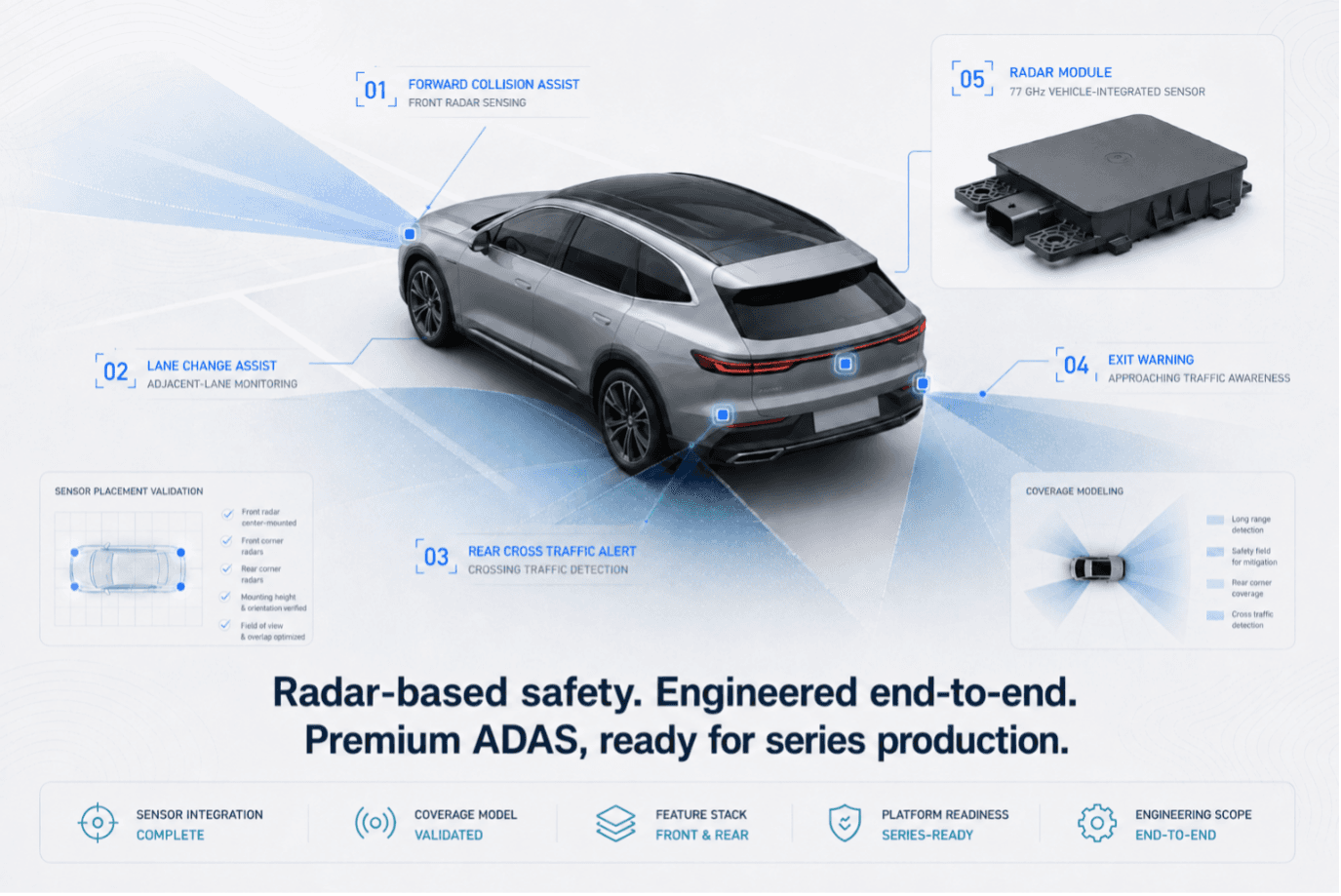
Radar-based safety. Engineered end-to-end.
Premium ADAS development for series production
Radar-based safety features are essential for modern ADAS, combining cost-efficient, flexible integration with robust performance in all weather conditions. They must detect, interpret, and react reliably across complex traffic environments while meeting the highest standards of functional safety, software quality, and series readiness.
For a premium automotive OEM, VAIVA delivered end-to-end development of multiple radar-based safety features across the full V-model. Our work spanned the engineering lifecycle, from function definition and system architecture to software development, software testing, and final system validation.
The project included complex new feature development and advanced algorithms validated on real‑world data, addressing real traffic situations through robust object prediction, trajectory and path processing. To effectively support a broad vehicle portfolio, the software architecture follows a modular and scalable design, ensuring reusability across projects and enabling seamless integration into the customer’s ADAS ecosystem.
To accelerate validation speed and issue resolution, VAIVA leveraged virtual simulation–based test scenarios for use-case-driven testing and pre-application evaluation. Identified issues could be analysed and resolved faster through resimulation, reducing manual effort and improving engineering confidence.
An automated testing toolchain further streamlined development and verification workflows. Combined with VAIVA’s in-house engineering processes, this enabled the project to successfully achieve ASPICE Level 2.
The radar-based safety feature was developed in compliance with ISO 26262 to ASIL B. In the customer’s Functional Safety assessment, the project achieved the highest maturity level.
The outcome: radar-based safety functions engineered with strong process maturity, functional safety expertise, automated validation, and series-production readiness.
Capability highlights
End-to-end development
From early concepts and system architecture to software realization, testing, and validationComplex radar feature development
Prediction, trajectory refinement & smoothing, and path algorithm development for premium ADAS functionsModular software architecture
Reusable and scalable software components for efficient integration and adaptationSimulation-supported validation
Virtual simulation–based test scenarios (e.g. CarMaker) for use-case-based testing, early evaluation, and fast issue resolution through resimulation. Thousands of hours driven on the virtual road to ensure no human is hurtAutomated testing toolchain
Streamlined verification workflows and improved development efficiencyProcess and safety maturity
ASPICE Level 2 achieved; ISO 26262 compliant ASIL B feature development