Defence
Occupant Protection Beyond Armor
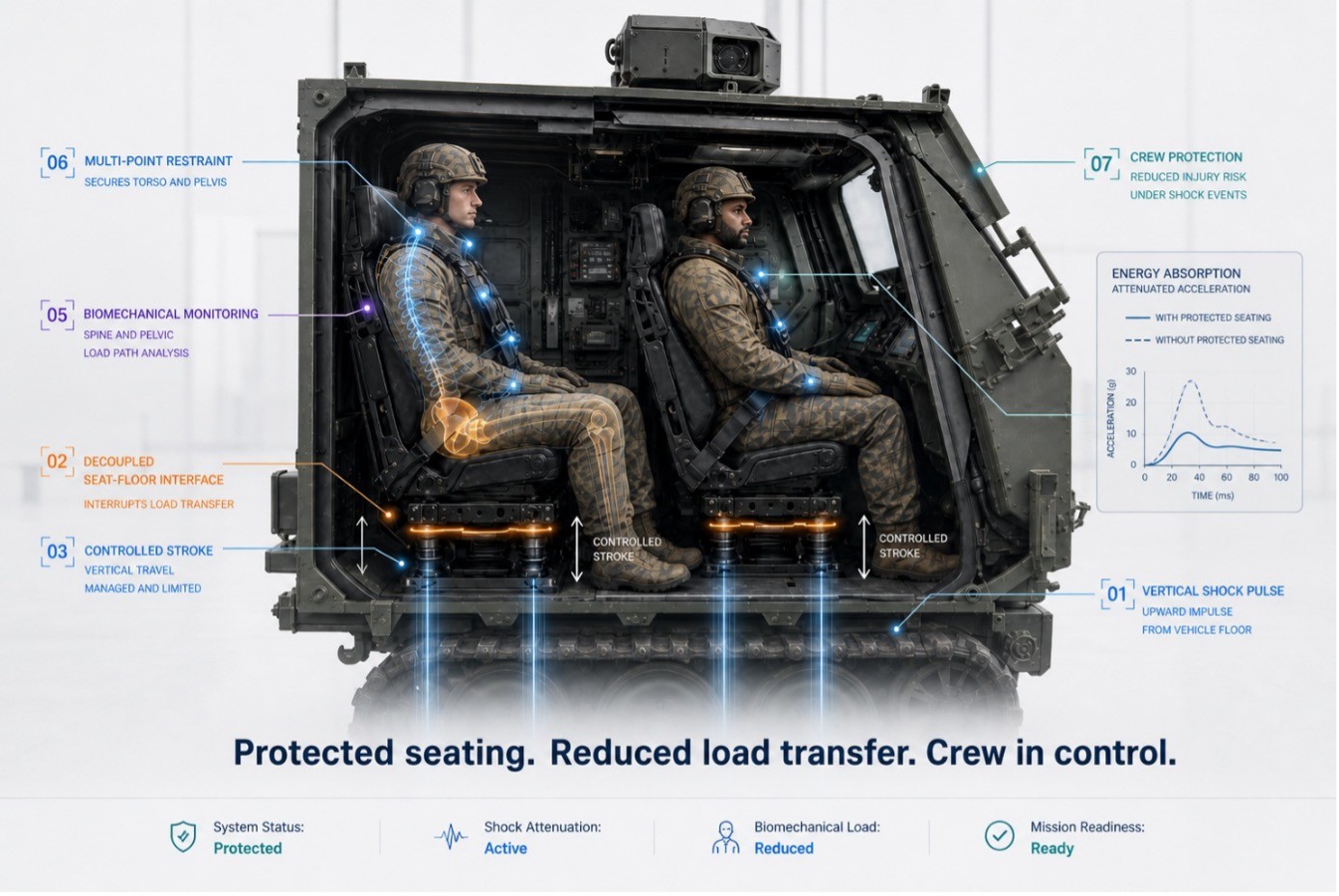
In future main battle tanks and protected mobility platforms, crew protection cannot rely solely on structural armor. If a mine or IED event occurs, the vehicle structure may protect against penetration, but the crew may still be exposed inside the vehicle to extreme accelerations, vertical shock, and uncontrolled load transfer.
These events are highly dynamic. Forces can be transferred from the vehicle floor into the seat, through the pelvis, and onward into the spine. Whether a crew member remains operational may depend on how precisely this energy is absorbed, redirected, and controlled.
With decades of experience, VAIVA develops occupant-protection concepts that view the seat system, restraint system, biomechanical monitoring, and energy absorption as an integrated safety function. The focus is on controlled load transfer rather than uncontrolled shock transmission.
The result: measurably reduced loads, improved survivability, and a faster return to operational readiness.
Designed for controlled energy absorption
A modern crew protection system must reduce biomechanical stress at the points where injuries are most likely to occur. In underbody blast and shock events, this means deliberately controlling the interaction between vehicle floor, seat structure, restraint system, and the human body.
VAIVA supports customers in developing systems in which the seat is not simply mounted on the platform, but is actively designed as a protective interface between vehicle and crew.
A future-ready system can include, among other things:
Decoupled seat-floor interface, to reduce the direct transfer of vertical accelerations during underbody blast events
Controlled seat stroke, to manage the energy path between floor motion and occupant loading
AI-supported energy absorption control, to tune adaptive seat structures and dissipate impact energy in a targeted way
Multi-point restraint systems, to stabilize torso and pelvis and reduce uncontrolled relative motion
Biomechanical load-path analysis, to understand how forces spread through the spine, pelvis, lower extremities, and torso
Human-centered safety logic, based on measurable body loads — not on generic protection assumptions
The goal is clear: reduce the forces reaching the crew, control how those forces are transferred, and keep the human operator protected and capable of action.
Biomechanics as a basis for decision-making
With decades of experience, VAIVA helps make biomechanically relevant loads visible, assessable, and reducible. By analyzing the temporal and spatial distribution of loads across individual body regions, protection systems can be optimized for the actual injury mechanisms that are decisive in vertical shock events.
This approach can support:
Analysis of spinal and pelvic loads to specifically reduce axial compression and pelvic acceleration
Seat stroke optimization, to balance energy absorption, available cabin space, and occupant motion
Design of restraint systems, to stabilize the body while avoiding risks of secondary injuries
Simulation of shock events, to evaluate seat and restraint concepts before physical testing
Crew readiness assessment based on measurable load exposure and system states
Design traceability from biomechanical requirements through seat architecture and restraint logic to the validation result
The advantage is a more precise engineering basis for protection: not simply “safer seats,” but quantifiable, explainable, and optimizable crew protection.
Intelligent seat and restraint systems
The core of the concept is an integrated protection architecture that connects seat mechanics, restraint strategy, sensor technology, simulation, and control logic.
Instead of treating the seat as a passive component, VAIVA supports the development of intelligent seat systems that can be tailored to expected load cases, occupant profiles, vehicle architecture, and mission requirements. Adaptive energy absorbers, controlled stroke mechanisms, and multi-point restraints can work together to reduce direct load transfer and limit secondary injuries caused by uncontrolled movement.
AI-supported engineering can help identify optimal energy absorption profiles, evaluate load paths, and support system calibration across different vehicle configurations and crew positions. Safety-critical behavior remains bounded, testable, and controllable.
This creates a protection concept that is robust in design and transparent in validation.
Crew protection as a mission function
Occupant protection is not just about surviving an event. It is also about maintaining operational capability.
A crew member exposed to reduced biomechanical loading is more likely to remain oriented, responsive, and mission-capable after a shock event. For future main battle tanks and protected vehicles, the design of seat and restraint systems thus becomes part of the overall mission system.
VAIVA's approach combines engineering precision with operational relevance:
Protected seating. Reduced load transfer. Crew in control.
Capability Section
Our work can include, among other things:
Decoupled seat-floor interface
Reduction of the direct transfer of vertical acceleration from the vehicle floor to the occupantControlled energy absorption
Design of seat structures and stroke mechanisms that absorb impact energy in a targeted and measurable wayAI-supported optimization
Use of data-driven methods to tune energy absorption profiles, seat behavior, and restraint concepts across relevant load casesMulti-point restraint systems
Stabilization of torso and pelvis to reduce uncontrolled occupant movement and secondary injury risksBiomechanical monitoring and load-path analysis
Assessment of forces along the spine, pelvis, lower extremities, and torso to optimize temporal and spatial load distributionSimulation and validation
Virtual testing of shock events, occupant kinematics, seat stroke, restraint interaction, and biomechanical load cases before physical validation