Defence
Secure Software Delivery for mission-critical defence systems
Mission systems, autonomy functions, optronics, support tools, embedded controllers, and digital interfaces must be developed and maintained under conditions that require both cyber resilience and engineering discipline.
At the same time, many defence programs continue to face fragmented toolchains, slow onboarding, inconsistent development environments, high manual effort, and security processes that take effect too late in the lifecycle.
VAIVA supports defence customers in building DevSecOps capabilities that bring software development, cybersecurity, validation, and operations together in a controllable engineering system — with our licensable VAIVA Engineering Platform, our Remote Integrated Development Environment, or AI-powered tooling.
A proven engineering framework, adapted for defence
VAIVA brings an ambitious development framework that has been shaped and refined over years in safety-related automotive series development projects. This foundation includes structured process models, strong verification logic, a proven toolchain approach, and continuous process improvement based on real project experience.
Our Engineering Platform is designed to be used directly in projects and — where appropriate — licensed as a reusable framework. It can be tailored to embedded and non-embedded software contexts and extended to meet customer-specific requirements, delivery models, and compliance expectations.
DevSecOps around secure, reproducible environments
One of the biggest bottlenecks in modern software programs is the development environment itself. Local workstation setups are slow, inconsistent, difficult to maintain, and often costly to secure across suppliers, distributed teams, and multiple project contexts.
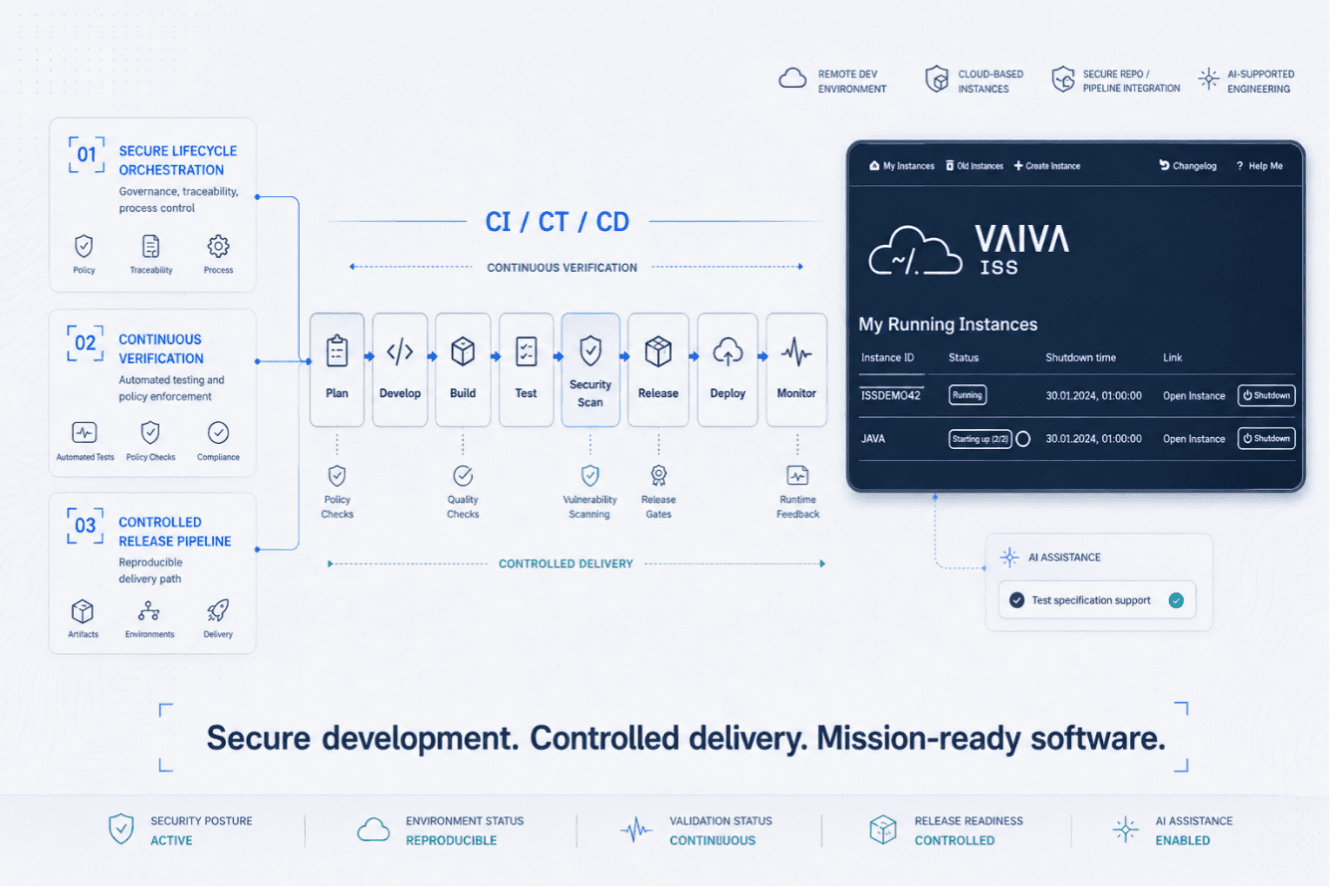
VAIVA addresses this with a Remote Integrated Development Environment approach that enables secure, reproducible development environments — accessible from different devices and locations. Development instances can be provisioned quickly, maintained consistently, and tightly integrated with source control, issue tracking, CI/CD workflows, and customer-specific toolchains.
This supports defence programs that need the following:
Faster onboarding of internal and external development teams
Consistent engineering environments across suppliers and locations
Reduced configuration drift and lower setup effort
Secure development workflows with controlled access and an integrated toolchain
Long-term maintainability of project environments
More efficient collaboration across complex program structures
The goal is clear: remove friction from the development environment while increasing control, consistency, and cyber resilience.
AI-powered engineering acceleration
VAIVA complements its software factory approach with AI-powered tools that accelerate development while safeguarding engineering quality. Depending on the use case, this can include support for:
Generation and refinement of test specifications
Structured support in verification workflows
Acceleration of documentation and traceability tasks
Improved consistency of development artifacts
Support for quality-oriented engineering activities throughout the entire lifecycle
This allows teams to reduce manual effort in repetitive engineering tasks while keeping humans in control of safety-critical and mission-relevant decisions.
Tailored to program realities
No defence program is identical. Platform architectures, networks, supplier structures, classification boundaries, customer processes, and mission profiles differ significantly.
That is why VAIVA’s DevSecOps offering is intentionally modular. We can provide building blocks, adapt existing customer ecosystems, or support the definition of a more comprehensive target picture for a software factory or engineering platform.
This can include, among other things:
Integration into customer-specific toolchains and CI/CD pipelines
Adaptation to project-specific process requirements
Support for embedded and non-embedded software projects
Alignment of engineering process, validation, and release logic
Establishment of reproducible development environments
Continuous refinement based on program feedback and evolving requirements
This makes the approach suitable both for modernizing existing development landscapes and for new program setups from the outset.
Capability Section
Our work can include, among other things:
Engineering Framework and Software Factory Design
Establishing structured, repeatable development processes based on proven engineering logic and continuous improvementSecure Remote Integrated Development Environments
Provisioning reproducible, centrally managed development environments that reduce onboarding time and improve consistency, security, and flexibilityCustomer-Specific Toolchain Integration
Connecting development workflows with source control, issue tracking, CI/CD, and customer-specific engineering ecosystemsShift-Left Testing and Security
Early integration of verification, validation, and cyber-relevant activities into the lifecycle through automation and continuous feedbackAI-Powered Engineering Tools
Accelerating quality-oriented engineering activities such as test specification support, documentation-related tasks, and structured development workflowsEmbedded and Non-Embedded Project Support
Adapting DevSecOps practices to software-product-related and platform-centered development contextsContinuous Improvement and Process Tailoring
Further developing processes, tooling, and automation based on project feedback, customer requirements, and program evolution